Feb 20, 2026
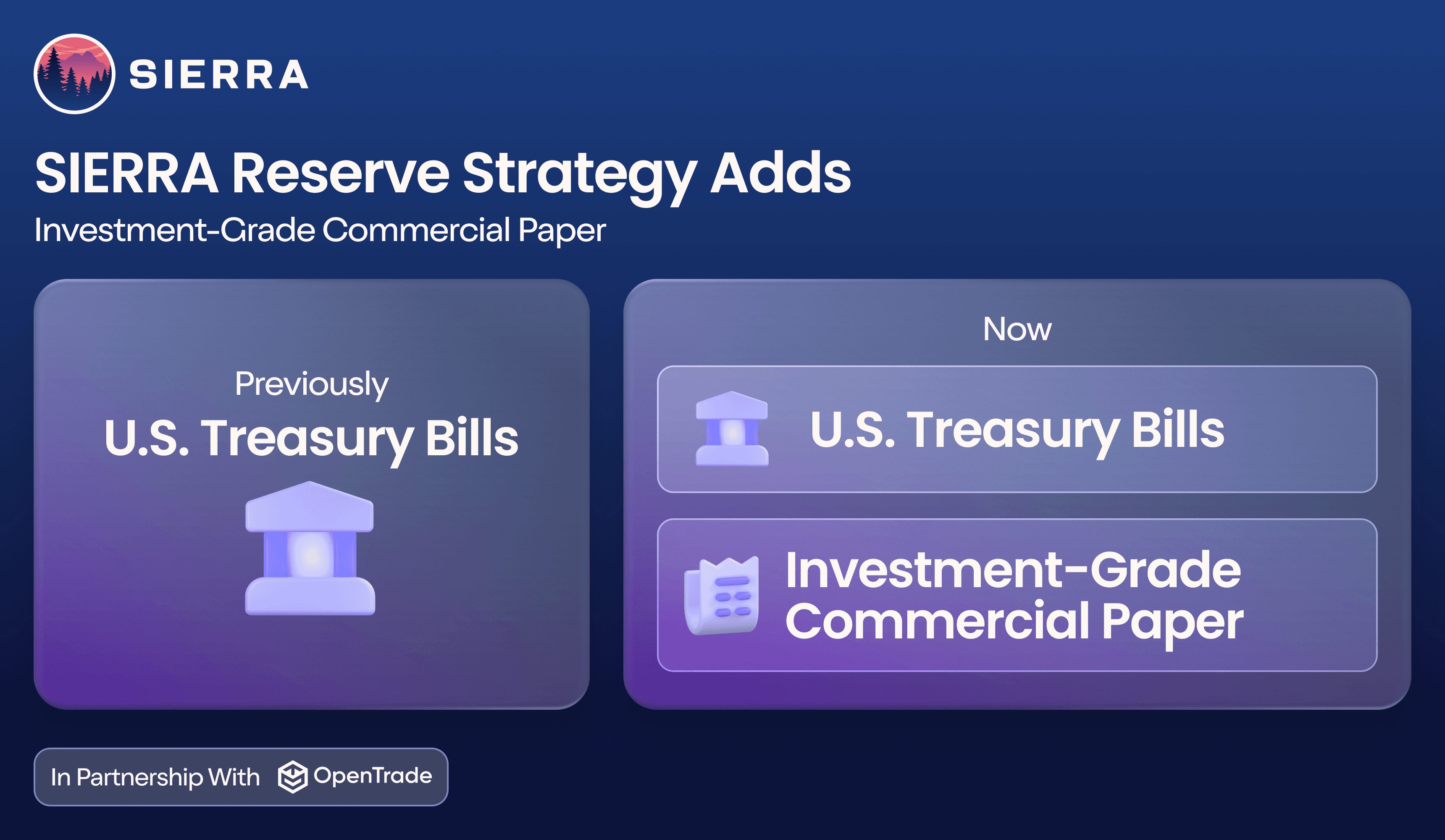
Sierra's Reserve Management Strategy now includes investment-grade commercial paper, expanding the real-world assets backing SIERRA beyond U.S. Treasury bills. This milestone makes SIERRA one of the first liquid yield tokens to allocate to commercial paper.
What is Commercial Paper?
Commercial paper (CP) is short-term debt issued by corporations and financial institutions to meet their working capital needs. These instruments are issued at a discount to face value and redeemed at par, similar to Treasury bills, with maturities typically ranging from a few days to several months.
The commercial paper market in the United States is approximately $1.4 trillion in size. Sierra's program focuses exclusively on USD-denominated commercial paper issued by investment-grade companies with maturities less than 90 days.
How Commercial Paper Differs from Treasury Bills
While both are short-term instruments, commercial paper and Treasury bills have different risk characteristics:
Credit Risk: Treasury bills are backed by the U.S. government, making them effectively risk-free. Commercial paper carries credit risk based on the issuing company's financial health.
Liquidity Risk: Treasury bills are among the most liquid assets in financial markets. Commercial paper, while still liquid, trades in a smaller secondary market. Sierra addresses this liquidity profile through strategic maturity laddering rather to minimize reliance on secondary market sales.
Duration Risk: Both instruments have low sensitivity to interest rate changes due to their short tenors. By holding maturities around 30 days, commercial paper investments have similar duration risk as short-dated Treasury bills already backing SIERRA.
Why Add Commercial Paper?
Sierra's reserve management strategy seeks to generate consistent, risk-adjusted yield. Commercial paper provides several benefits:
Enhanced Yield: The credit spread over Treasury bills directly increases yields on the reserves backing SIERRA
Scalability: Given the breadth of the commercial paper market, Sierra can scale up its allocation to commercial paper without reducing yields
Diversification: Yields across DeFi have compressed over the past few months so adding more RWA yield sources help Sierra to adjust its reserve management strategy in response to market conditions
Maintained Liquidity: Through maturity laddering, Sierra ensures regular cash flows minimizing reliance on secondary market liquidity
Credit Quality and Risk Management
Through partnering with OpenTrade, an institutional-grade yield-as-a-service platform, and Five Sigma Finance, an FCA-regulated asset manager, Sierra has developed a framework for investing in commercial paper.
The investment universe of commercial paper issuers that Sierra can allocate to are limited to investment-grade credit ratings to minimize risk of default. Additionally, short tenors of less than 90 days and a target average maturity of 30 days supports liquidity in the portfolio. The portfolio is diversified across multiple issuers, sectors and geographies to help further improve risk-adjusted returns.
OpenTrade and Five Sigma manage the operational workflows for commercial paper through its institutional-grade infrastructure. All RWA collateral, including commercial paper, is held in secured accounts with Tier-1 financial institutions.
Transparency and Reporting
Sierra's commitment to transparency extends to commercial paper holdings. The protocol's Transparency Dashboard provides real-time visibility into its investments in OpenTrade’s commercial paper vault named “xIGCP”. Weekly vault reports from Five Sigma detail the underlying assets backing SIERRA, enabling holders to independently verify reserves.