Nov 18, 2025
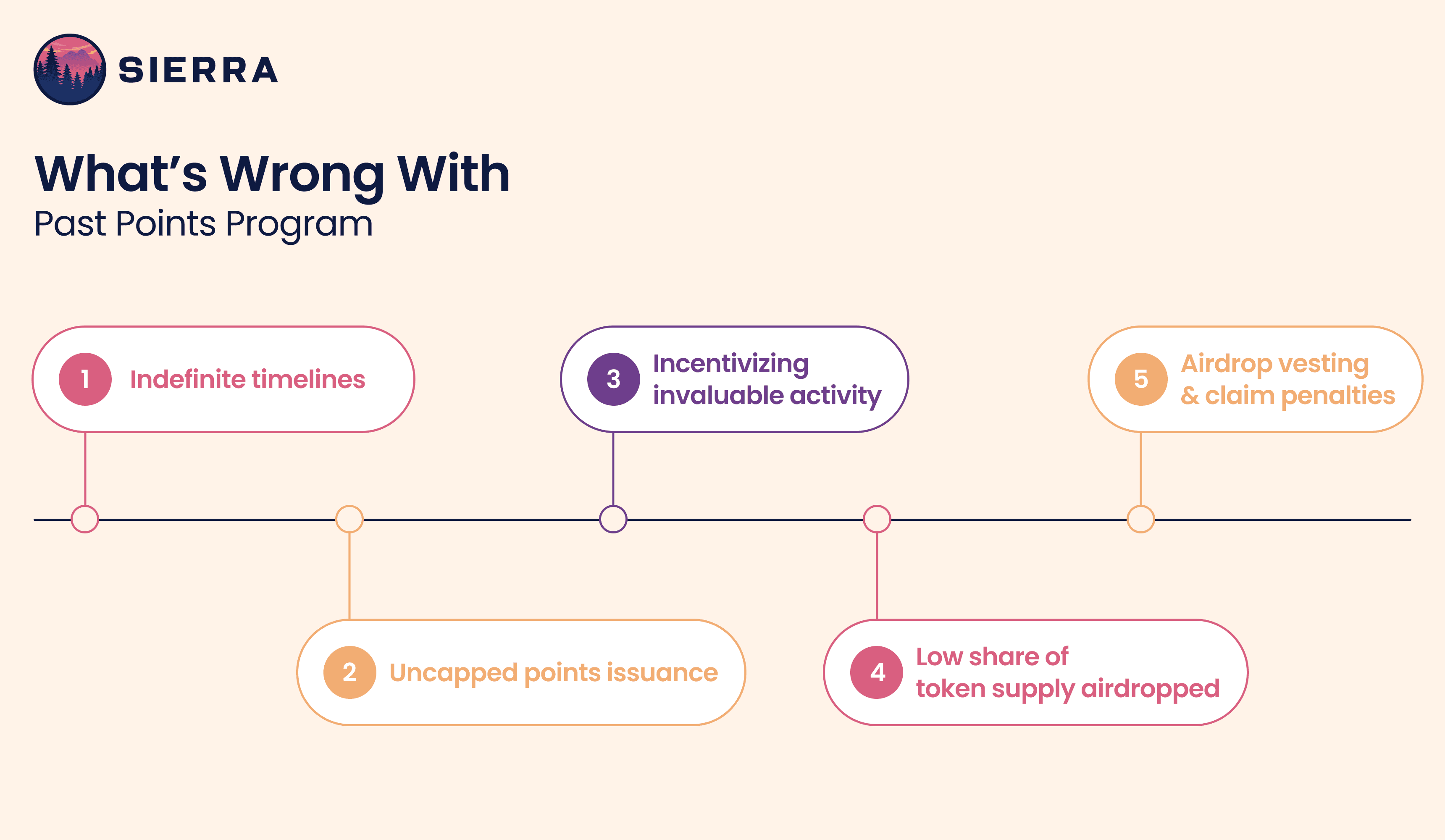
What’s the point of a point?
Points programs have become the default way through which projects incentivize early participation and distribute tokens via an airdrop. Their efficacy in attracting attention and generating hype around a project launch is undeniable, but all too often that impact is short lived.
Sierra is fortunate to be in the position where we can learn from previous programs - what worked well, what not so much - and incorporate those lessons into how we designed our own, beginning from first principles. Importantly, this is not meant to be a condemnation of any prior programs (aside from those that were explicitly predatory), but simply an objective evaluation.
Novel protocols are surrounded by complex ecosystems and designing new, well-balanced incentive mechanisms is a complicated task. It is our opinion that when there is a feeling of ill-will from a community following a points campaign, the usual common denominator is that participants felt misled or taken advantage of, rather than be appreciated for their contributions. Now, do not get us wrong - there is undoubtedly a subset of users out there who are entirely mercenary and will never be happy with what they receive.
That population is never going away, nor is this article for them. But for the majority of users that are earnestly spending their time and perhaps even capital to help support a protocol in its early days, there should be recognition that any future success is built upon the early faith they show.
The Sierra Protocol is built upon a foundation of transparency, simplicity, and community, and its upcoming points program is designed to reflect those principles.
As such, we are taking this opportunity to share the framework for Sierra’s upcoming points program, beginning in November. We aim to create a program rooted in simplicity and clarity in order to provide an avenue through which all contributors to the SIERRA network can be fairly rewarded as we all build this together.
Transparency
We believe that transparency in all aspects is non-negotiable. From day one, Sierra will provide industry-leading transparency in all aspects of the protocol, from yield sources to governance, and everything in between. Our upcoming points program is the next place we can demonstrate that commitment.
Frequently, whether intentionally or unintentionally, we see teams make missteps that violate the trust of their community. This comes in a variety of flavours, but some of the most common seem to be:
“Farming the Farmers”
In these cases, points inflate indefinitely and the total amount of points distributed over time is ever increasing. There is also no predefined end date and the program continues on for an indefinite amount of time. Teams will do this to prolong their elevated ‘usage’ metrics - but to what end?
Unfortunately, there are many examples of programs ending in no airdrop at all. More often than not, users that feel ‘farmed’ become disillusioned or fed up, and rather than stay on as champions, they simply cash out and move on.
Shifting Sands
Teams, if done right, have their points program designed from the start. Sure, there should be room for flexibility and tweaks, but by and large, the general structure will be mostly locked in. Despite this, teams frequently provide little, if any, information for participants to make informed decisions.
Frequently, we also see teams making changes late in the points campaign with unexpected negative effects for participants (i.e. right before TGE announcing that points will convert to a vested airdrop allocation when participants expected the airdrop to be fully liquid, for example).
All relevant details should be clearly explained from the outset.
Inflate to Infinity
How much is 1,000,000 points for protocol X worth? What share is that of the total points allocation? How does that compare to the 9 points I have on protocol Y? Is my contribution somehow less valuable because I made it on day 1 of the protocol’s life instead of on day 200?
With points inflation - both in terms of amount awarded per season/epoch/week/campaign and in terms of total awarded overall - it is nearly impossible to understand the directional value of what any given contribution is worth.
Ideally, teams prioritize point distribution towards the most impactful activities - users should be aware of what those are and be rewarded commensurately.
So, how is Sierra addressing these with its upcoming points program?
There is one single points campaign that will end at TGE of the governance token for the Sierra Protocol. And then that is it, no more seasons that simply result in ongoing inflation. There is also a capped amount of total points in the program. We have predefined allocations to distribute for each activity, for every single week we expect the program to be live. If some of those points happen to go unallocated, they won’t be recycled, meaning every other point earned becomes a relatively larger share of the fixed pie. TGE is expected to happen no later than 2Q 2026, full stop.
If the protocol is at a stage that merits moving this sooner based on community feedback, that can happen. Again, this would only reduce the total number of total points issued, thus making every earned point represent a higher portion of the total points allocated. Ways to earn points will be clearly outlined on Sierra’s points dashboard, as will weekly allocations earned by each address.
Simplicity
Every team has a different reason for doing a points campaign. Some do it because ‘that’s just the thing to do’, while others do it to incentivize specific behaviours that represent core functionality for their protocols or target core KPIs they want to achieve. The latter is correct, in our opinion, but is where unnecessary complexity may start to creep in. A few examples:
Point Splitting
Teams often end up splitting points across too many activities, especially within the same type (i.e. incentivizing LPing on multiple DEXes on the same chain at once).
This makes the points program unnecessarily difficult to implement on the team’s end while also bifurcating key onchain dynamics that the points program was meant to bolster in the first place. At point-campaign-stage of development, focus should be concentrated on highest-impact outcomes.
Incentivizing Extraneous Activities
Frequently programs allocate points to things that do not bring adequate value back to the ecosystem or provide the team with any real, valuable insights.
What good does incentivizing 5 transfers do? Besides inflating a vanity metric, this will likely just be someone constantly transferring between their own addresses while really not contributing anything of value back to the broader ecosystem.
Excessive Requirements
Implementing excessive vesting or other penalties and restrictions on the points program are often unnecessary complications. There is undoubtedly rationale (e.g. limiting sell pressure, trying to incentivize longer-term alignment), but often this is done because other aspects of the program are driving users towards the undesired behaviors these are trying to prevent, and these are implemented as necessary ‘fixes’.
So, how is Sierra addressing these with its upcoming points program?
We have a limited set of activities that we believe are core to growing the SIERRA ecosystem that align with our own major KPIs or are specifically geared towards incentivizing behaviour in a way that allows us to develop aspects of the network in a very targeted manner.
These activities will be made visible on our points dashboard. At a high level, this means that we will allocate points in very concentrated directions and calculated linearly - splitting wallets to sybil is pointless.
Perhaps most importantly, there are as few restrictions, lockups, vesting or other requirements attached to the points as possible. We believe what we are building will be attractive enough for the community to want to stay active and engaged. And if not, no problem - the quicker we understand our true level of traction vs. point-inflated inorganic numbers, the better.
Community
Who’s the most important community member: the first to contribute to SIERRA, or the last?
Trick question - they both are. But many programs don’t treat contributors this way. All too often there are incredible discrepancies between various stakeholders, whether role or time involved. Can this be completely eliminated? Not entirely, but we can make best efforts to ensure fairness where we can and at the very least provide as much transparency as possible up front out of respect to all involved.
“Let Them Eat Cake” Mentality
This is perhaps the biggest issue most have with the vast majority of programs these days: points that are ultimately for a tiny portion of token supply.
Thousands of users contribute to the product’s success, but the team hardly tosses them a bone resulting in the now-classic low-float, high-FDV structure that almost without fail leads the community to feel like nothing more than simple exit liquidity.
Constant Points = Constant Devaluation
Some programs elect to issue a constant amount of points over time making it less attractive for later participants to join once the points campaign becomes more popular. For example, if 10,000 points are awarded for supplying DEX liquidity during the first epoch and there were 5 active LPs, that means there was 2,000 points for each.
Fast forward 15 weeks and now there are still 10,000 points awarded but there are now 500 LPs providing the same capital, working out to just 20 points for each. Are those later LPs 100x less valuable than the first? Definitely not! But structures like this implicitly value contributions that way.
Who are you again?
Programs frequently fail to reward early participants, and more importantly, continued activity. If someone is an early contributor and continues to participate for many months, they should be rewarded with more points than someone who participates in the same way, but for just one week.
So, how is Sierra addressing these with its upcoming points program?
Off the top, we believe there is one way to ensure we put our best foot forward by the time the points campaign winds down: go big! One team cannot build the entire network alone, so why treat stakeholders like we did?
When a points campaign results in peanuts for the community, while the team and investors reap the rewards, that carries a very explicit lack of respect for the community members that helped build the network into what it is by the time a token is warranted. We refuse to do that and believe in maximizing community distribution as fast as possible.
Now, bullets 2 and 3 above can at times be in conflict with each other, and it is a tricky balance to strike. How can you make it attractive for the next marginal community member to participate while still ensuring the earliest feel seen?
One way is to reserve a sizable allocation of points that are ear marked for consistent value-additive contributions over the long term. Things like simple wash trading and circular transfers are useless, so that won’t cut it and will be ignored.
But high-value contributions spread across time and across activity - especially organic adoption as an actual user - should absolutely be rewarded. As participation and activity increases, weekly points issuance should grow commensurately.