Jan 15, 2026
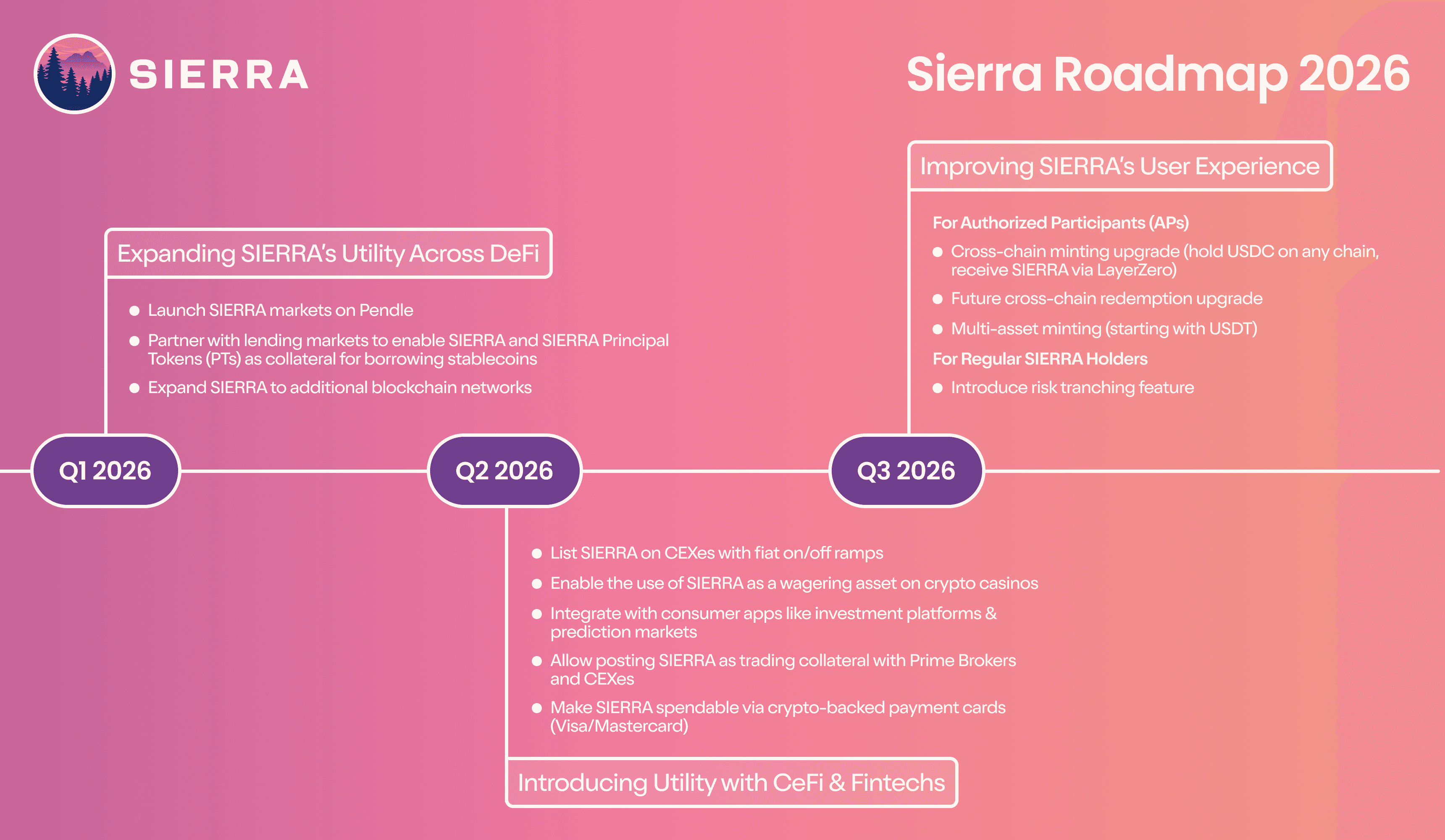
The Sierra Protocol was launched in November 2025 with SIERRA as the first Liquid Yield Token (LYT) with a flexible and diversified reserve management strategy. Since launch, Sierra has experienced meaningful adoption, established several key partnerships and streamlined its operational processes.
Looking forward to 2026, we have several major goals to improve the utility of SIERRA, increasing access and distribution, and introducing meaningful governance and decentralization of the Sierra Protocol.
Expanding SIERRA’s Utility Across DeFi
Through the end of 2025, SIERRA users could earn intrinsic yield by simply holding SIERRA in their wallet. More sophisticated users could compound their yield earned by providing liquidity on DEXes like LFJ and Uniswap through earning intrinsic yield, trading fees and additional LP incentives. Cross-chain bridging of SIERRA with zero slippage between Ethereum and Avalanche was made possible through our partnership with LayerZero and Stargate Finance.
In early 2026, one of our primary goals is to expand SIERRA’s utility across DeFi. A major initiative here is launching SIERRA markets on Pendle, which enable users to speculate on changes to SIERRA’s yield, as well as locking in a fixed rate of yield. Additionally, we will partner with several lending markets and curators to enable users to pledge SIERRA and SIERRA Principal Tokens (PTs) as yield-bearing collateral to borrow stablecoins. These partnerships enable users to further amplify their returns through arbitraging the difference between yields paid by SIERRA and SIERRA PTs and stablecoin borrowing costs on lending markets.
In order to further expand SIERRA’s utility across DeFi, we will expand upon our partnership with LayerZero by launching SIERRA on more blockchain networks. Each network has its own core user base and native applications, so expanding to more networks enables SIERRA to unlock further utility and expand its distribution. Through leveraging LayerZero’s OFT standard, deploying SIERRA to new blockchains with zero slippage is very scalable.
Introducing Utility with CeFi and Fintechs
Since launch, we have focused on DeFi’s permissionless structure as a starting point for adoption and distribution. In 2026, we are focused on expanding adoption and distribution across CeFi and fintech platforms through developing key partnerships and introducing utility for SIERRA. Some major initiatives include:
Listing SIERRA as a tradeable asset on CEXes, especially platforms with fiat on and off ramps and located in regional markets with strong demand for yield-bearing, stablecoin-denominated assets. These platforms will help expand distribution through abstracting the complexity of self-custody, dealing with gas fees and using DEXes
Enabling SIERRA to be used as a wagering asset with crypto casinos, where users can grow their bankroll through passively earning SIERRA’s intrinsic yield
Integrating SIERRA with consumer applications, such as investment platforms where users pledge stablecoins for weeks and forego yield and prediction markets where users do not earn yield on their long-term positions
For more sophisticated retail and institutional users, they can post SIERRA as trading collateral with Prime Brokers and CEXes. This enables improved capital efficiency and enhanced returns through earning intrinsic yield on top of existing trading strategies
Making SIERRA a spendable asset with crypto-backed payment cards, so users can save by holding SIERRA instead of stablecoins while being able to spend it globally anywhere Visa and Mastercard are accepted
Becoming a “risk-off” yield asset with VCs and hedge funds, where these institutional investors can allocate their idle assets to SIERRA to generate returns and mitigate cash drag in between deploying capital
Improving SIERRA’s User Experience
From the outset, the design and implementation of SIERRA has been focused on delivering the best user experience across all LYTs. In 2026, we’re expanding upon this objective by improving the minting and redeeming process for Authorized Participants (APs). The first upgrade we’re working on will enable crosschain minting of SIERRA tokens. Currently, APs must have USDC on Avalanche to mint SIERRA. After the upgrade, APs could hold USDC on other chains and through LayerZero’s OFT infrastructure, they would receive newly minted SIERRA on other chains. A further upgrade will enable crosschain redemptions but this requires a larger build since redemptions are asynchronous whereas minting SIERRA is atomic.
Another major upgrade we’re working towards is multi-asset minting. Currently, APs can only mint SIERRA against native USDC on Avalanche. In the future, we envision APs having the ability to mint SIERRA with other stablecoins, starting with Tether’s USDT. This is a major improvement in further abstracting the user experience since nearly all other LYTs have a singular base asset and issue separate LYTs for different base assets.
For the normal SIERRA holder, a major new feature in 2026 will be our risk tranching feature. The risk tranching feature is envisioned as a smart contract where users lock their SIERRA tokens for a period of time, such as 2 weeks. While locked, depositors earn SIERRA’s intrinsic yield and additional yield through Peaks and in the future SGT emissions. As a depositor, your SIERRA is “junior” to normal SIERRA holders. This means that a loss of SIERRA’s reserves due to a smart contract exploit of a yield source or borrower default would first be borne by depositors in the risk tranching smart contract. Hence, this product is designed for users who want higher yield and are more sophisticated to be able to underwrite the additional risk they are taking. For the normal SIERRA holder, this product means that they are more insulated from any issue that negatively affects SIERRA’s underlying reserves.
Enhancing SIERRA’s Reserve Management Strategy
A unique differentiator of Sierra is its use of OpenTrade’s platform for reserves management. Since the platform is agnostic to yield types across both RWAs and DeFi, Sierra can seamlessly add new yield sources as they pass Sierra’s Risk Framework.
Throughout Q1 and Q2 of 2026, new yield sources will be evaluated and integrated into Sierra’s reserve management strategy. Some target candidates include:
SuperState’s USCC, which generates yield via basis trades on the Chicago Mercantile Exchange (CME) as the largest regulated crypto derivatives exchange
Pendle PTs, which are similar to zero-coupon bonds that provide a fixed rate of return that is fully realized at the end of the term. Each underlying token will be individually evaluated for potential risks according to Sierra’s Risk Framework
Commercial Paper, which has yields above U.S. Treasury Bills in exchange for the credit and liquidity risk associated with investment-grade issuers
AAVE Horizon, which is the institutional deployment of AAVE and offers higher USDC lending rates than the standard USDC market on Ethereum
OpenTrade’s Figment SOL Staking Basis Vault, which has been built in partnership with Figment to generate yield from staking SOL and hedging the market risk by shorting perpetual futures to capture the funding rate and staking returns as yield
There is a long list of potential yield sources that require more diligence but may pass Sierra’s Risk Framework and be added to Sierra’s Reserve Management Strategy. Some examples include private liquidity deals hosted by Turtle, early deposit opportunities on promising new blockchains and tokenized private credit funds.
Decentralizing the Sierra Protocol
As outlined in the Summit Program blog, the program will conclude by the end of Q2 2026 coinciding with the token generation event (TGE) of the Sierra Governance Token (SGT). A core goal of the Summit Program is to distribute a meaningful share of SGT’s total supply to core stakeholders and contributors of the Sierra Protocol, which are users and partners of SIERRA. By achieving this distribution, the future governance of the Sierra Protocol will be controlled by those with the most skin in the game.
Post-TGE, the Sierra Protocol will undergo a gradual transition towards decentralized governance. Some core features of decentralized governance could include:
Updating Sierra’s Risk Framework
Adding and removing yield sources to Sierra’s Reserve Management Strategy
Changing fees and other revenue parameters
Designing and implementing value accrual mechanisms from revenue of the Sierra Protocol to holders of SGT
Appointing and removing members of Sierra’s Advisory Council
Spending funds held by Sierra’s Treasury
In the long run, the Sierra Protocol will be able to operate in a decentralized manner without on-going efforts and control held solely by the team. Instead, we envision a future where a broad group of aligned stakeholders steer the Sierra Protocol through discourse and voting as holders of SGT. This outcome will be achieved through transitioning control of key parameters of the Sierra Protocol and assets in Sierra’s treasury to the community of SGT tokenholders and encouraging active participation in governance and stewardship.
Closing Thoughts
The past year involved months of designing, building and launching the Sierra Protocol. These efforts laid the foundation for a year of growth, refinements and maturation throughout 2026. Looking ahead, the next twelve months represent the opportunity to expand SIERRA’s utility across DeFi, introduce utility with CeFi and Fintech platforms, improve its user experience, enhance the reserve management strategy and most importantly, decentralize the Sierra Protocol. We hope you join us on this journey and consider contributing meaningfully, as it will not be an easy journey but it is certainly a worthwhile one!